
What Is Tasbih? The Complete Guide to Meaning, History, Beads, and Digital Counters
If you’ve ever seen a string of beads moving through someone’s fingers during or after prayer, you’ve seen a tasbih — one of the most recognizable tools in Islamic daily practice. But despite how common it is, most people have never had it explained properly: what it actually means, where it came from, why the bead count matters, and what a digital tasbih counter actually is compared to the physical version.
This guide covers all of that in one place. If you want to start counting right now rather than read the theory first, the free online tasbih counter works directly in your browser — no installation, no sign-up, and your progress saves automatically.
Table of Contents
- What Does Tasbih Actually Mean?
- Tasbih vs Misbaha vs Subha — Same Thing, Different Names
- Why Do Muslims Use Tasbih?
- The Origin and History of Tasbih
- How Many Beads Are in a Tasbih? (33, 99, 100, 313, 1000)
- How to Do Tasbih (Step by Step)
- Tasbih and Dhikr: How They Relate
- What Is a Digital Tasbih Counter?
- How to Use a Digital Tasbeeh Counter (Step by Step)
- Tap Counter vs Tasbih Counter
- Also Known As (Other Languages)
- Frequently Asked Questions
What Does Tasbih Actually Mean?
The word tasbih (تسبيح) comes from the Arabic root sabbaha, meaning “to glorify” or “to declare free from imperfection.” In practice, it refers to two connected things:
- The phrase itself — saying “Subhanallah” (“Glory be to Allah”), which is an act of tasbih
- The physical tool — the string of beads used to count repetitions of that phrase (and others)
So when someone says “I did my tasbih today,” they usually mean they completed a set count of glorification phrases — and when someone holds up a tasbih, they mean the beads used to track that count. Both meanings are correct; context makes clear which one is meant.
Tasbih vs Misbaha vs Subha — Same Thing, Different Names
Depending on the region, you’ll hear the same object called by different names:
| Name | Common Region |
| Tasbih / Tasbeeh / Tasbeh | South Asia, general use |
| Misbaha / Masbaha | Arabic-speaking countries |
| Subha / Sebha / Sibha | Levant, North Africa |
| Tespih / Tesbih | Turkey |
| Tasbih Zähler | Germany / German-speaking regions (“Zähler” = counter) |
| Mala | Comparative term — used in Hindu/Buddhist prayer, not Islamic practice, but often searched alongside tasbih since both are counting beads |
These aren’t different objects or different practices — just regional naming for the exact same tool and purpose. You’ll also see the recitation itself written as tashbih, tasbeeh, tasbee, or occasionally misspelled as tasbi or tazbee — all pointing to the same word.
Why Do Muslims Use Tasbih?
The tasbih exists to solve a very practical problem: accurately counting repeated remembrance without losing track. Islamic practice includes several forms of dhikr that are meant to be recited a specific number of times — 33, 99, or 100 being the most common. Trying to hold that number in your head while also focusing on the meaning of what you’re saying is difficult, especially past the first 20 or 30 repetitions.
The tasbih removes that mental burden. Each bead moved is one repetition counted, leaving your attention free for the recitation itself rather than the arithmetic behind it.
This is why the tasbih shows up so consistently around daily practice — after salah (the five daily prayers), during taraweeh in Ramadan, while reciting durood or salawat, during dua, and even while performing tawaf around the Kaaba on Hajj or Umrah. Anywhere a Muslim is repeating bismillah, kalma, takbeer, or istighfar a set number of times, a tasbih is the natural tool for keeping the count accurate.
The Origin and History of Tasbih
The use of counting tools for repeated prayer or remembrance is old and appears across multiple religious traditions — Buddhist and Hindu practice uses a mala, Christian tradition uses the rosary, and Islamic practice uses the tasbih. Within Islam specifically, the tasbih became closely associated with counting the number of times Subhanallah, Alhamdulillah, and Allahu Akbar are recited after the five daily prayers, as well as counting the 99 Names of Allah (Asma ul Husna).
Over centuries, tasbih beads were crafted from a wide range of materials — wood, amber, agate, pearl, and sandalwood among the most traditional — and the design spread across the Arab world, South Asia, Turkey, and beyond, with regional differences in bead count, material, and craftsmanship, but an identical underlying purpose.
How Many Beads Are in a Tasbih? (33, 99, 100, 313, 1000)
The most common tasbih lengths are directly tied to specific dhikr counts — none of them are arbitrary:
| Bead Count | What It’s Used For |
| 33 beads | Used three times in sequence for the 33-33-34 dhikr recited after each prayer (Subhanallah x33, Alhamdulillah x33, Allahu Akbar x34) |
| 99 beads | Matches the 99 Names of Allah (Asma ul Husna) — one full lap covers all names |
| 100 beads | A rounded, general-purpose count for open-ended dhikr |
| 313 beads | Less common, used in some traditions for extended dhikr sessions |
| 1000 beads | Used occasionally for long-form dhikr sessions, such as extended istighfar or salawat counts |
A digital tasbih counter (covered fully below) removes the need to match a physical bead count to your goal — you simply set the target number yourself.
How to Do Tasbih (Step by Step)
Using a tasbih is simple by design, whether with physical beads or on your fingers:
- Choose your dhikr — Subhanallah, Alhamdulillah, Allahu Akbar, or any phrase of remembrance
- Decide your count — commonly 33, 99, or 100
- Hold the string between the thumb and index finger, moving one bead per repetition
- Continue to the end of the string, or to a marker/divider bead if present (many tasbihs include one at the 33-count mark to help track the 33-33-34 sequence)
- Repeat for each phrase — for example, 33 Subhanallah, then 33 Alhamdulillah, then 34 Allahu Akbar
There’s no fixed rule requiring a specific hand or grip, and no requirement to use beads specifically — this same method works identically using a digital tasbih counter instead, especially useful once you’re past 30–40 repetitions and want certainty over your exact count.
Tasbih and Dhikr: How They Relate
It’s worth being precise about this distinction, since the two words are often used interchangeably but mean different things:
- Dhikr is the act of remembrance — the recitation itself, in any form, with or without a counting tool
- Tasbih is the tool used to count that recitation, and specifically refers to the tasbih phrase (“Subhanallah”) as well as the beads themselves
In other words, dhikr is what you’re doing; tasbih is how you’re keeping count of it. You can perform dhikr without a tasbih at all — on your fingers, silently, or using a digital counter.
What Is a Digital Tasbih Counter?
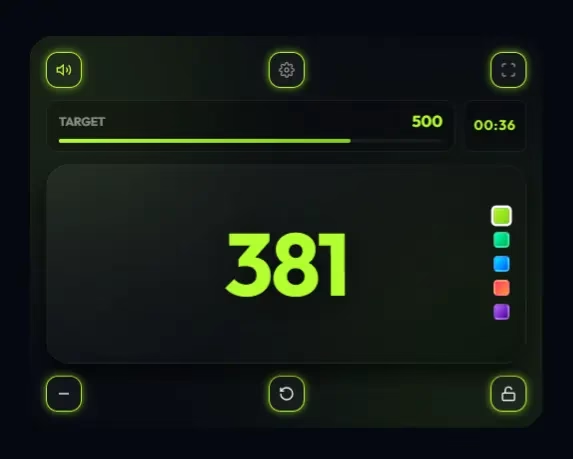
A digital tasbih counter is a tool — an app, website, or small electronic device — that counts each repetition of dhikr with a single tap, replacing the need to move a physical bead. Every tap adds one to a running total shown on screen, and most tools let you set a target (like 33, 99, or 100) so you know exactly when you’ve completed a set.
A digital tasbeeh is the exact same thing — “tasbih” and “tasbeeh” are simply two common spellings of the same word, so a “digital tasbeeh,” “digital tasbih,” and “digital tasbih counter” all refer to the identical tool.
Today this takes several forms: a dedicated app (available as an apk on Android or through the app store on iOS), a browser-based website that needs no installation at all, or even a small electronic ring or clicker device worn on the finger. Each is really just a different piece of software or hardware built around the same simple mechanism — a counter, a button, and a running total.
Digital counters add a few practical advantages over a manual count: an always-visible running total, custom targets (33, 99, 100, 313, 1000, or any number you set), auto-save so a count is recorded and never lost even if you close the app or go offline, and the ability to track more than one dhikr at a time without switching beads. If you don’t have a physical tasbih on hand, don’t want to manage a separate app, or simply prefer a precise visible count, a free online tasbih counter works the same way directly in your browser — no download, no login, and no software to manage.
How to Use a Digital Tasbeeh Counter (Step by Step)
- Set your target — enter 33, 99, 100, or any custom number
- Set your step (optional) — choose how much each tap adds, usually 1
- Tap to count — each tap increases your total by one, visible instantly on screen
- Listen for the alert — most counters play a sound when you hit your target, so you don’t need to watch the screen
- Reset — clear the counter with one tap to start your next set
Because the count auto-saves, you can close the page mid-count and pick up exactly where you left off — something a physical tasbih can’t do if you lose your place.
Tap Counter vs Tasbih Counter
A tap counter is the general term for any tool that increases a number by one with each tap — used for reps, attendance, laps, or inventory, not just dhikr. A tasbih counter is simply a tap counter applied specifically to counting dhikr. The mechanism is identical; only the purpose differs, which is also why many “tasbih counter” tools double as general tally counters.
Also Known As (Other Languages)
A digital tasbih counter is searched for under several regional names, all referring to the same tool: tesbih online (Turkish), online zikirmatik (Turkish, referring to a dhikr-counting device), tasbih zähler online (German), tasbee (alternate spelling), and тасбих (Russian). Whichever term you search, you’re looking for the same function.