
Tasbih Fatima RA: Complete 33-33-34 Dhikr Guide, Meaning, and Counting Method
Introduction
If you’ve ever heard someone mention “33-33-34” or “Tasbih Fatimi” after prayer, they’re referring to one of the most widely practiced forms of dhikr in Islam: reciting SubhanAllah, Alhamdulillah, and Allahu Akbar a set number of times. This single tasbih carries two names, two hadith contexts, and a story tied directly to the household of the Prophet Muhammad ﷺ — yet most guides online only explain half of it. This article covers the full picture: where the name “Tasbih Fatima” comes from, the exact wording and count, who can practice it, how long it takes, the difference between reciting it after salah and reciting it before sleep, the scholarly variations, and a simple step-by-step method for counting it accurately, whether by hand or with a digital tasbih counter.
Table of Contents
What Is Tasbih Fatima (RA)?
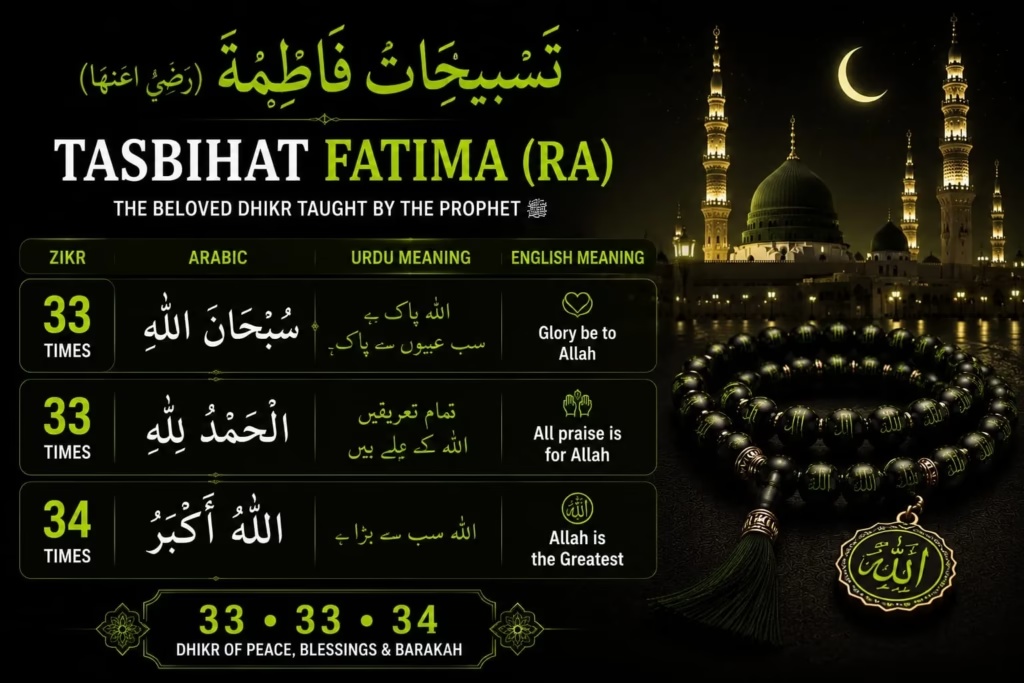
Tasbih Fatima — also written Tasbeeh Fatimi, Tasbih al-Zahra, or Tasbih Hadhrat Zahra — is a specific dhikr sequence consisting of three phrases repeated a fixed number of times:
- SubhanAllah (Glory be to Allah) — 33 times
- Alhamdulillah (Praise be to Allah) — 33 times
- Allahu Akbar (Allah is Greatest) — 34 times
Together these add up to 100 units of remembrance. The name “Tasbih Fatima” refers to Fatimah az-Zahra, radiyallahu anha, the daughter of the Prophet Muhammad ﷺ, because of the hadith explaining how this exact dhikr was first taught to her.
The Hadith Story: Fatima (RA), Ali (RA), and the Prophet ﷺ
The origin of this dhikr is recorded in detail in Sahih al-Bukhari, narrated by Ali ibn Abi Talib, radiyallahu anhu, himself. The background: Fatimah az-Zahra, radiyallahu anha, had been grinding grain by hand at the hand-mill day after day, work that left her hands worn and exhausted. When she heard that a group of captives from the spoils of war had been brought to the Prophet ﷺ, she went to his quarters hoping to ask for one of them as a household helper. She didn’t find him at home, so she mentioned her request to Aisha, radiyallahu anha, and asked her to pass it on.
Later that night, the Prophet ﷺ came to the home Fatimah az-Zahra shared with Ali ibn Abi Talib. By then the couple had already gone to bed. When they moved to get up out of respect, he told them to stay where they were, and sat down between them. Ali ibn Abi Talib later recalled feeling the coolness of the Prophet’s ﷺ feet against his chest as he sat there. Rather than granting the request for a servant, the Prophet ﷺ asked them if he could tell them of something better than what they’d asked for. He then taught them the dhikr: SubhanAllah 33 times, Alhamdulillah 33 times, and Allahu Akbar 34 times, to be recited on going to bed each night.
In a related narration recorded in Sahih al-Bukhari, Ali ibn Abi Talib added that he never once left off reciting it after that night. When someone asked him whether that included the night before the Battle of Siffin — one of the most difficult, high-stakes nights of his life — he confirmed that even then, he had not abandoned it. This detail is often cited to illustrate the reassurance and steadiness the dhikr was meant to provide, not just as a nightly formality but as something to hold onto under real pressure.
This is why the dhikr is sometimes called Tasbih Fatima or Tasbih al-Zahra — “az-Zahra” (the Radiant) being one of the honorific titles of Fatimah, radiyallahu anha — it was a personal gift of remembrance from the Prophet Muhammad ﷺ to his own family, offered as spiritual and physical relief rather than material help.
Who Was Fatima (RA)? A Short Biography
To understand why this particular dhikr carries her name, it helps to know who Fatimah az-Zahra, radiyallahu anha, was. She was the youngest daughter of the Prophet Muhammad ﷺ and his first wife, Khadijah bint Khuwaylid, radiyallahu anha, born in Mecca a few years before the start of revelation. She lost her mother while still young, in the year Islamic tradition remembers as “the Year of Sorrow” (Aam al-Huzn), and grew especially close to her father afterward — close enough that he affectionately called her “Umm Abiha,” meaning “mother of her father,” for how she cared for him.
She married her cousin, Ali ibn Abi Talib, radiyallahu anhu, in Medina in the early Medinan period, and the marriage lasted for the rest of her life. Together they had four children who survived infancy: their sons Hasan and Husayn, and their daughters Zainab and Umm Kulthum — a fifth child, a son named Muhsin, is reported in some narrations to have died in infancy or before birth. Her household was known for modesty and hardship rather than comfort; the hand-mill grinding described above was part of her ordinary, physically demanding daily life.
Fatimah az-Zahra is known by several honorific titles across Islamic tradition, including al-Zahra (“the Radiant”), al-Batul (“the pure, dedicated one”), and Sayyidat Nisa al-Alamin (“chief of the women of all worlds/times”), the last of these coming from a hadith in which the Prophet ﷺ describes her standing among women the way he stands among prophets. She passed away in Medina only a matter of months after her father ﷺ, in the same year, at a young age. The precise circumstances and timing of her death, along with several events in the period immediately following the Prophet’s ﷺ passing, are recounted differently in Sunni and Shia historical sources; this article focuses on the dhikr itself rather than that contested history, and readers interested in it are encouraged to consult dedicated biographical sources from within each tradition.
Tasbih Fatima (RA) After Salah vs Before Sleep
The same 33-33-34 sequence appears in a separate, also authentic hadith — this time narrated by Ka’b ibn ‘Ujrah — describing it as dhikr to be recited after each of the five daily obligatory prayers. Because the wording and count are identical to the bedtime dhikr taught to Fatimah az-Zahra, radiyallahu anha, and Ali ibn Abi Talib, radiyallahu anhu, scholars generally treat them as the same tasbih applied in two different moments of the day: once after salah, and once before sleep.
In practice, this means you’re free to recite Tasbih Fatima at both times — there’s no conflict between the two hadiths, and many practicing Muslims do both as part of their daily routine.
Are There Different Versions of Tasbih Fatima?
Some hadith narrations describe the takbir count as 33 rather than 34, followed by a single recitation of the tahlil (La ilaha illallahu wahdahu la sharika lahu, lahul-mulku wa lahul-hamdu, wa huwa ‘ala kulli shay’in qadir) to complete the round of 100. Imam Nawawi noted that both versions are found in authentic hadith and suggested a combined approach: reciting Allahu Akbar 34 times and adding the tahlil afterward, so that neither authentic version is left out. Either method — 33/33/34 alone, or 33/33/34 plus the closing tahlil — is considered correct.
A related variation is the order of the phrases. Some narrations, particularly within Shia scholarship, describe the sequence starting with Allahu Akbar (34 times), then Alhamdulillah (33 times), then SubhanAllah (33 times), closing with the tahlil. Both the “SubhanAllah-first” and “Allahu Akbar-first” orderings are recited by Muslims today; the total count of 100 and the three phrases involved stay the same, only the sequence and the closing tahlil differ by narration and regional custom.
How to Perform Tasbih Fatima (RA): Step by Step
- Set your intention (niyyah) — a brief, silent intention that you are reciting this dhikr for the sake of Allah is enough; no specific wording is required.
- Choose your moment — immediately after completing an obligatory prayer, or right before going to sleep.
- Recite SubhanAllah 33 times, keeping count on your fingers, prayer beads, or a digital counter.
- Recite Alhamdulillah 33 times, continuing the same count method.
- Recite Allahu Akbar 34 times to complete the round of 100.
- Optional: close with the tahlil once, if following the combined method.
On hand position: there’s no single mandatory hand posture. Most people count on the joints and tips of the right-hand fingers (a method attributed to the Prophet ﷺ in hadith on counting tasbih on the fingers) or use a string of 33 or 100 prayer beads held in the right hand. Both are valid; the finger-counting method is often preferred because, unlike beads, it doesn’t require carrying anything.
Who Can Recite Tasbih Fatima? Beginners, Elderly, Men, and Women
Tasbih Fatima has no prerequisites. A few common questions:
- Beginners: Because it only involves three phrases and simple counting, it’s often recommended as a first dhikr for new Muslims or anyone starting a daily remembrance practice — no memorized Arabic passages or specific sitting position are required.
- Men and women: The dhikr is not gender-restricted. Unlike salah, tasbih can be recited during menstruation or postpartum bleeding, since dhikr (unlike prayer) does not require a state of ritual purity (wudu).
- Sick or elderly people: It can be recited lying down, sitting, or in any physically comfortable position, silently or in a whisper, which makes it accessible for people who are unwell, in pain, or unable to perform other physical acts of worship.
- Children: It’s commonly one of the first dhikr routines taught to children because the counting itself (fingers or a simple counter) helps hold their attention.
Is Tasbih Fatima Practiced by Both Sunni and Shia Muslims?
Yes, though its prominence differs between the two traditions. The core hadith — the Prophet ﷺ teaching Fatimah az-Zahra and Ali ibn Abi Talib to recite SubhanAllah 33, Alhamdulillah 33, and Allahu Akbar 34 before sleep — is recorded in Sahih al-Bukhari and Sahih Muslim, both foundational Sunni hadith collections, and the practice is followed by Sunni Muslims worldwide as part of the broader after-salah and before-sleep dhikr tradition.
In Shia Islam, the same dhikr holds a more elevated, formally named status as “Tasbih al-Zahra” or “Tasbih Fatima al-Zahra,” transmitted through narrations attributed to the Imams of the Ahl al-Bayt, including Ja’far al-Sadiq and Muhammad al-Baqir, who are reported to have described it as more beloved to them than lengthy voluntary prayers. It’s treated as one of the most emphasized daily devotional acts in Shia practice specifically because of its direct connection to Fatimah az-Zahra and the Ahl al-Bayt.
In short: the dhikr itself is shared scripture across both traditions, but the title “Tasbih Fatima” and the depth of devotional emphasis placed on it are more closely associated with Shia practice, while Sunni Muslims more commonly refer to the same recitation simply as the dhikr after salah, without necessarily using the “Tasbih Fatima” name. Both usages are religiously valid within their respective traditions.
Virtues and Rewards of Tasbih Fatima (RA)
Multiple hadith describe significant rewards tied to this dhikr, including the forgiveness of minor sins for those who complete it consistently after every prayer. The Prophet Muhammad ﷺ described it to Fatimah az-Zahra, radiyallahu anha, as better than a servant — meaning its spiritual and practical benefit outweighs even physical assistance with hardship. For this reason, it’s counted among the emphasized Sunnah practices (Sunnah mu’akkadah) rather than a strict obligation, meaning it’s strongly encouraged without being mandatory.
On the “joints” connection: a separate but related hadith (recorded in Sahih Muslim and Sahih al-Bukhari) states that every one of the roughly 360 joints in the human body has a charity due on it each day, and that a single utterance of tasbih, tahmid, takbir, or tahlil counts as charity for one joint. While this hadith is distinct from the 33-33-34 narration, it’s the reason many scholars describe daily dhikr like Tasbih Fatima as a way of “covering” that daily obligation of gratitude through remembrance rather than money.
On mental and emotional wellbeing: Tasbih Fatima isn’t presented in the hadith literature as a clinical treatment, but the general Islamic teaching that hearts find rest in the remembrance of Allah (Qur’an 13:28) is commonly cited by scholars and counselors as the basis for why structured dhikr — including this specific tasbih — is often recommended alongside, not instead of, professional support for anxiety, stress, or difficulty winding down before sleep. Reciting it before bed, as originally taught to Fatimah az-Zahra, radiyallahu anha, is the version most people associate with relaxation, since it closes the day with a fixed, repetitive routine rather than open-ended worry.
References consulted for accuracy: Sunnah.com hadith collection, Wikipedia: Tasbih of Fatimah, and IslamQA. See the full References section at the end of this article for hadith-by-hadith source links.
How Long Does Tasbih Fatima Take, and How Do I Stay Consistent?
A full round of 100 recitations typically takes two to four minutes at an unhurried pace, which is one reason it’s recommended as a daily habit even for people with very little spare time. To stay consistent:
- Attach it to something you already do every day — right after the final prayer of the night, or right before you turn off the light — instead of treating it as a separate task.
- If you miss a day, there’s no makeup requirement or penalty in the hadith; simply resume the next opportunity without treating the gap as a failure.
- A counter with a visible daily streak or history (digital or paper) helps far more than memory alone for noticing — and fixing — gaps in a routine.
Tips for Remembering the Words and Staying Focused
Because Tasbih Fatima is only three short Arabic phrases, most people memorize it within a few repetitions, but a few things help:
- Learn it in chunks: master SubhanAllah x33 alone for a few days before adding Alhamdulillah, then Allahu Akbar, rather than trying to recite all three phrases from memory on day one.
- Say it, don’t just read it: reading from a book or app is completely valid and doesn’t reduce the reward, but saying the words out loud (even quietly) tends to fix them in memory faster than silent reading alone.
- Slow the pace down to stay focused on meaning, rather than rushing through the count. If your mind wanders mid-count — which is normal and expected — the general scholarly guidance is simply to gently bring your attention back to the words and continue; there’s no requirement to restart the whole set because of a wandering thought, only if you’ve genuinely lost track of the number.
- Verify your recitation against a trusted source (a hadith app, a local imam, or an audio recitation) rather than relying on word-of-mouth versions, since minor mispronunciations don’t invalidate the dhikr but can drift from the correct wording over time.
Can I Recite Tasbih Fatima While Doing Other Tasks, or Combine It With Other Dhikr?
Tasbih Fatima doesn’t require standing still or facing the qiblah, so it can be recited silently while walking, commuting, doing housework, or any task that doesn’t require your full verbal or mental attention elsewhere. Many people specifically use it to fill otherwise idle moments in the day.
It can also be combined with other forms of dhikr — istighfar (seeking forgiveness), salawat (sending blessings on the Prophet ﷺ), or Ayat al-Kursi are commonly recited alongside it as part of a broader after-salah or before-sleep routine. There’s no hadith restricting Tasbih Fatima to being recited on its own; it’s simply one recommended element within a larger practice of daily remembrance.
Frequently Asked Questions
Is Tasbih Fatima (RA) the Same as the Dhikr Recited After Salah?
Yes. Both refer to the same SubhanAllah 33, Alhamdulillah 33, Allahu Akbar 34 sequence. The name “Tasbih Fatima” points to its origin as a bedtime dhikr taught to Fatimah az-Zahra, radiyallahu anha, and her husband Ali al-Murtada, radiyallahu anhu, by the Prophet Muhammad ﷺ, while “dhikr after salah” describes the same recitation used following the five daily prayers.
Should the takbir be said 33 or 34 times?
Both counts are found in authentic hadith. 34 is the more commonly practiced version; some scholars recommend 33 followed by a single tahlil to complete 100, and Imam Nawawi suggested combining both to be safe.
Can I recite Tasbih Fatima both after salah and before sleep?
Yes. The two hadiths describe two separate occasions for the same dhikr, and there’s no restriction on reciting it at both times in the same day.
Do I need prayer beads to count Tasbih Fatima?
No. It can be counted on the fingers, with prayer beads, or using a digital tasbih counter — the method of counting doesn’t affect the validity of the dhikr, only the accuracy of the count.
What happens if I lose count partway through?
There’s no penalty for losing count — simply restart that phrase from the beginning, or use a counter with a visible running total to avoid the issue altogether.
Can I recite Tasbih Fatima in English instead of Arabic?
The wording is typically recited in Arabic because that’s the language of the original hadith, but reciting the English meaning is generally considered acceptable for people still learning the Arabic phrases, especially beginners. Most scholars recommend transitioning to the Arabic wording once it’s memorized, since the specific Arabic phrases are what’s referenced in the hadith count.
Is Tasbih Fatima better than other forms of dhikr?
The hadith literature describes it as exceptionally rewarding — the Prophet ﷺ told Fatimah az-Zahra it was better than a servant, and later scholars like Ja’far al-Sadiq are reported to have valued it above lengthy voluntary prayer — but Islamic tradition doesn’t present dhikr as a competition. It’s better understood as one of the most emphasized and accessible daily practices rather than a replacement for other recommended dhikr like istighfar or salawat.
Can Tasbih Fatima help with sleep?
Reciting it right before bed is literally how it was first taught, and its short, fixed, repetitive structure is the kind of wind-down routine many people find calming before sleep. It isn’t a substitute for addressing ongoing sleep problems with a doctor if they persist.
How did the Prophet Muhammad ﷺ come to teach this dhikr?
According to the hadith in Sahih al-Bukhari, Fatimah az-Zahra came to the Prophet ﷺ asking for help with the physical labor of grinding grain by hand. Rather than assigning her a servant, he visited her home with Ali ibn Abi Talib one night and taught them this recitation instead, describing it as more valuable than what she’d asked for.
Should I read Tasbih Fatima from a book, app, or memorize it?
Either is fine, and reading it doesn’t reduce its reward. Memorizing it simply makes it easier to recite anywhere — while walking, lying down, or in the dark before sleep — without needing to hold a phone or book.
References
Primary hadith sources and supporting references used in this article:
- Sahih al-Bukhari 3113 — the full account of Fatimah az-Zahra’s request for a servant and the Prophet ﷺ teaching her the 33-33-34 dhikr instead. sunnah.com/bukhari:3113
- Sahih al-Bukhari 5362 — Ali ibn Abi Talib’s narration confirming he never abandoned the dhikr, including the night before the Battle of Siffin. sunnah.com/bukhari:5362
- Sahih Muslim, Book of Dhikr — parallel narration of the same bedtime dhikr taught to Fatimah az-Zahra and Ali ibn Abi Talib. Referenced via sunnah.com.
- Hadith of Ka’b ibn ‘Ujrah (recorded in Sahih Muslim and Sunan Abi Dawud) — the 33-33-34 dhikr recommended after each of the five obligatory prayers. Referenced via sunnah.com.
- Hadith on the 360 joints and daily charity — Sahih al-Bukhari 2989 and Sahih Muslim 1009 (Abu Hurayrah), and the Aisha narration in Sahih Muslim 1007, on tasbih, tahmid, and takbir standing in for the daily charity due on each joint. See hadeethenc.com and abuaminaelias.com.
- Imam Nawawi’s combined-count explanation (33 takbir + tahlil, or 34 takbir alone) — as discussed in classical commentary on Sahih Muslim; summarized via Sunnah.com and IslamQA.
- Qur’an 13:28 — cited for the general principle behind dhikr and emotional calm.
- Biographical detail on Fatimah az-Zahra (birth, family, titles, marriage, children) — Wikipedia: Fatima, World History Encyclopedia: Fatimah bint Muhammad.
- On the dhikr’s status across Sunni and Shia practice — WikiShia: Lady Fatimah al-Zahra, Al-Islam.org, and general Sunni hadith collections cited above (1–4).
- Wikipedia: Tasbih of Fatimah — general overview and cross-referencing of variant narrations. en.wikipedia.org/wiki/Tasbih_of_Fatimah
Note: hadith wording above is paraphrased rather than quoted verbatim from any single translation; for the exact Arabic and a literal English translation, follow the Sunnah.com links directly.
About the Author
Abdullah Zulfiqar writes and researches the Islamic-practice guides on Online Tasbih Counter, checking every hadith cited against primary sources like Sahih al-Bukhari and Sahih Muslim before it’s published. He built the site’s free tasbih counter after repeatedly losing count mid-recitation, and keeps building tools the same way — spot the pain point, then fix it. Contact